


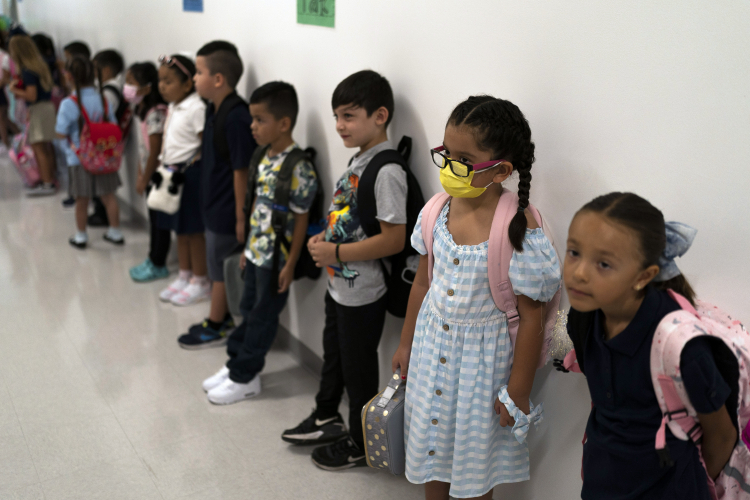
As students return to classrooms, the educational effects of the pandemic remain unfinished business. More than six years after schools first closed, achievement remains below 2019 levels in many districts. Researchers are still trying to determine how much the nearly $190 billion in federal emergency aid helped students recover.
A new working paper from the National Bureau of Economic Research (NBER) appears to offer a discouraging verdict. It finds that additional federal aid did not increase school spending or improve student test scores in the districts the researchers studied.
That conclusion seems to conflict with research from the Education Scorecard and the Center for Analysis of Longitudinal Data in Education Research, or CALDER. Both found that federal pandemic aid contributed to academic recovery, particularly in mathematics and in high-poverty districts.
But the studies are not as contradictory as they first appear. Together, they offer a more useful lesson. It’s not enough to ask whether money matters. Policymakers must ask whether federal aid becomes additional education spending, where it goes, and whether schools use it for activities likely to improve learning.
Congress created the Elementary and Secondary School Emergency Relief Fund, known as ESSER, through three pandemic relief packages. The money helped schools reopen, address health and safety concerns, stabilize the K-12 workforce, and respond to historic declines in student achievement. Districts had considerable freedom in using the funds, with only 20 percent of the largest package having to address K-12 learning loss.
The NBER study examines districts near a federal funding threshold that caused otherwise similar systems to receive different amounts of aid. This creates a valuable natural experiment.
The researchers found that districts receiving additional federal money reduced locally raised revenues, including property-tax collections. As a result, the federal funds did not produce a comparable increase in per-pupil spending. Nor did the additional aid reduce test-score losses, although it was associated with greater enrollment, faster reopening, and increased political engagement.
The headline, more federal money did not improve achievement, is accurate but incomplete. The federal dollars apparently substituted for local revenue rather than increasing the total resources devoted to schools. The study therefore tells us more about the design of these types of grants rather than about the effect of additional education spending.
The analysis also examines a narrow group of relatively low-poverty districts around the funding threshold. Its findings should not automatically be extended to high-poverty districts, which received much larger ESSER allocations and had less capacity to replace local revenue with federal money.
The Education Scorecard’s May 2026 report examines thousands of districts across the income spectrum. It estimates that every additional $1,000 per student in federal pandemic aid was associated with roughly six additional days of learning in both math and reading between 2022 and 2025. The gains were modest, but measurable.
The largest apparent effects occurred in high-poverty districts. According to the Scorecard, without federal aid, the average high-poverty district would have experienced virtually no mathematics recovery and further reading declines after 2022.
Still, the Scorecard does not declare ESSER an unqualified success. The highest-poverty districts remain about half a grade level below their 2019 achievement. The estimated return per dollar resembles the effect of a general increase in school revenue, not the much larger gains sometimes produced by well-designed tutoring or extended-learning programs.
Research from CALDER falls between the two studies. It examined almost 5,000 districts in 28 states and found that each additional $1,000 in ESSER spending produced a statistically significant but modest improvement in mathematics. The estimated reading effect was smaller and not statistically significant. They calculated that ESSER accounted for about 18 percent of the mathematics recovery and 12 percent of the reading recovery during the 2022–23 school year.
Taken together, the evidence points to five lessons.
· Federal grants do not necessarily produce dollar-for-dollar increases in school spending. States and districts may reduce their own contributions, intentionally or otherwise. Future federal programs should include transparent maintenance-of-effort provisions and report changes in federal, state, and local revenue, not federal allocations alone.
· Averages conceal important differences. Federal aid may have functioned largely as fiscal relief in some affluent communities while providing genuine additional resources in high-poverty districts. Policymakers should resist using results from one type of district to characterize the entire program.
· Additional money can improve achievement, but the effects are usually modest. ESSER appears to have accelerated mathematics recovery and helped prevent the poorest districts from falling further behind. It did not erase the pandemic losses.
· How money is used matters. ESSER supported legitimate needs beyond academics, including ventilation, technology, staffing, and reopening. But if the primary goal is improving achievement, future aid should create better incentives for evidence-based tutoring, summer learning, high-quality curriculum, additional instructional time, and other interventions with demonstrated academic effects.
· Money can’t compensate for students who are not in school. The Scorecard estimates that achievement recovery would have been larger if absenteeism had returned to pre-pandemic levels. Attendance must therefore be treated as an academic strategy, not merely an administrative concern.
The emerging verdict on ESSER is neither that money did not matter nor that federal spending rescued American education. The aid helped some districts and students, especially where it became additional resources. But its academic return was limited by loose targeting, fiscal substitution, uneven implementation, and persistent absenteeism.
That is not an argument against federal assistance. It is an argument for designing that assistance more carefully. The next time Washington sends billions of dollars to schools, policymakers should specify the problem the money is meant to solve, ensure that it supplements rather than replaces existing resources, and require evidence that students received something more than a larger federal appropriation. That’s a back to school lesson worth learning.
Read Full Article »