No, Virginia, Collective Bargaining Isn’t Related to Better Student Outcomes

A recent claim about collective bargaining by a Virginia teacher is reminiscent of a lesson used by the late Senator Daniel Patrick Moynihan to help fellow Democrats understand that there is no connection between school funding and student achievement.
Noting that northern states tended to have better outcomes, Moynihan, with tongue planted firmly in cheek, exclaimed, "If you want to improve your state's math scores, move your state closer to the Canadian border!"
Moynihan was pointing out the flaw of a simple bi-variate analysis, wherein an association is made with two variables. Variable #1 (math scores) and variable #2 (proximity to Canada) may be accurate, but that doesn’t mean that one is caused by the other.
Tim Klobuchar, a teacher at Monticello High School in Virginia, made a Moynihan-like statement about collective bargaining last week, except he was being serious.
“It’s not a coincidence that the strongest performing states in K-12 education also happen to have strong collective bargaining practices in their schools.”
Now, it’s true that some states have better outcomes than others, and it’s also true that some states are more heavily unionized than others, but the two are no more related than math scores and proximity to the Canadian border.
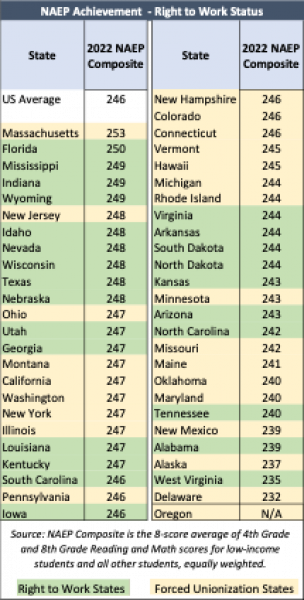
There is no data comparing the relative strength of collective bargaining practices among school districts across the nation, but we can compare the performance of Right to Work states and those with forced unionization. A new analysis by the Kansas Policy Institute assigned a composite score to each state in the adjacent table, comprised of the eight primary measurements from the 2022 National Assessment of Educational Progress (NAEP) – 4th Grade and 8th Grade reading and math scores for low-income students and those who are not low-income, all equally weighted.
State averages cannot be used because there are large achievement gaps between the two student cohorts, so a state with a higher percentage of low-income students can appear to have lower outcomes simply because of demographics.
This analysis shows that eight of the ten states with the highest NAEP composite are Right to Work states, as are 15 of the top 25 states.
That’s not to say that those states have higher scores because of their Right to Work status, but it casts strong doubt on collective bargaining impacting student outcomes.
Some education officials contend that higher spending produces better outcomes, but again, the data shows otherwise.
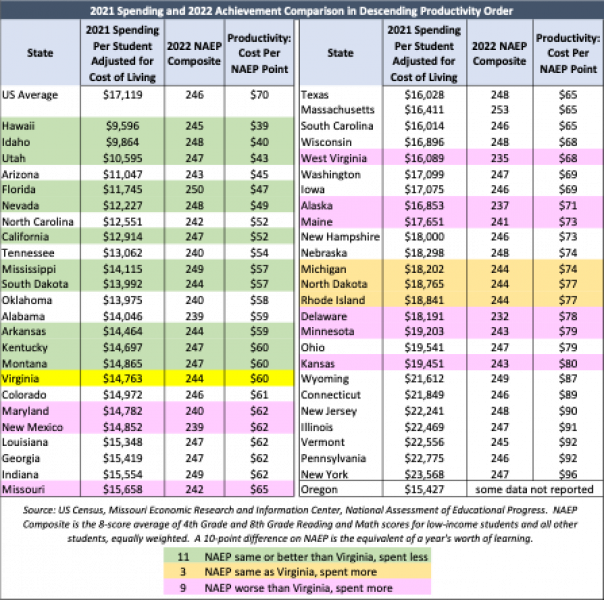
The table below compares the same NAEP composite scores with the most current per-student spending data from the U.S. Census Bureau, adjusted for the cost of living in each state. A cost-of-living adjustment that reflects the same purchase power for each state is necessary because a dollar spent in a state like Kansas buys a lot more than a dollar spent in a state like New York.
The results of the spending and achievement comparison are stunning:
– 11 states got the same or higher NAEP score as Virginia but spent much less.
– 3 states got the same NAEP score as Virginia but spent a lot more.
– 9 states scored worse than Virginia and spent a lot more.