


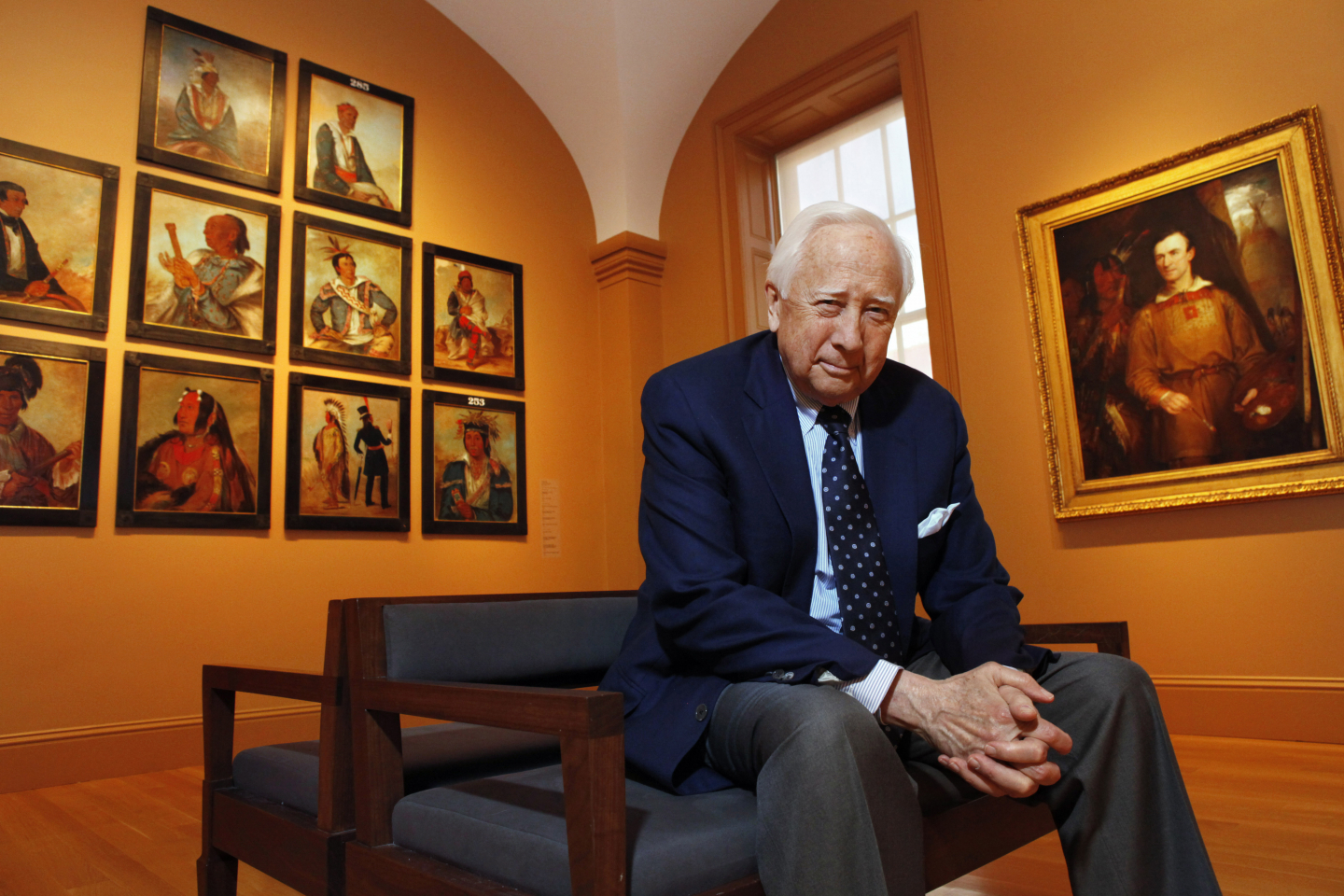
David McCullough and the Study of History

One of the greatest weeks of my life was the week David McCullough came to teach a one-credit course at Hillsdale College in 2006. McCullough, the great writer and teacher of history, held forth on the craft of writing, led us in a discussion of a primary source reading from the pen of John Adams, and held office hours with the largest gathering of students I ever saw in the faculty office building. I realized then that some people make more of a difference in a week’s time in the lives of people around them than many others make over the course of years. David McCullough made a profound difference that week and over his 89 years.
One of the bits of advice McCullough shared with us at Hillsdale, and that I’ll never forget, is advice that was handed down to him from Thornton Wilder when he taught at Yale: if there is something you want to read, and it isn’t written, go out and write it.
Not long after college, I took that advice and began work on a project to document the experience of my hometown in Washington State during World War II. I knew there was a narrow window of opportunity to talk to men and women of the World War II generation, so I talked to as many as I could. I interviewed 120 veterans, friends, and family of men who were killed in the war, and Japanese-Americans who had been interned in the local fairgrounds. When I wondered if I was spending too much time on the project, I thought back to the advice of David McCullough, and of Thornton Wilder before him—I knew I needed to learn about the “Greatest Generation” and what it took to win the Second World War, and I knew I needed to share what I learned with others around me. I published Puyallup in World War II in 2018.
My project was no McCullough masterpiece, but that doesn’t diminish the power of his encouragements to so many people like me to study and write about history. McCullough didn’t just want people to read his books; he wanted others to experience the joy and meaning of in-depth historical study and research for themselves. He went around encouraging people about this. At the 2002 National Book Festival, he commended “the pull, the excitement, the detective-case excitement of historic research.”
This is one among many wonderful McCullough reflections on history as a craft compiled by McCullough’s daughter, Dorie McCullough Lawson, and research associate Michael Hill. Their marvelous volume, History Matters, includes speeches and writings about the importance of history: essays on books and heroes, and delightful stories about human character as only McCullough could tell them. Here are chapter-length entries on George Washington, Harriet Beecher Stowe, and Harry Truman; memories of people McCullough knew, like the public intellectual Arthur Schlesinger, Jr., and the southwestern novelist-historian Paul Horgan; even a digest of McCullough’s book recommendations from a lifetime of reading.
Through this collection, McCullough seems to be on a mission, a mission to persuade his readers or listeners to pay attention to the history all around them. History was so much more than a recitation of facts or a chronological sequence. It was the living record of humanity, and its study could be the source of endless joy and wonder for anyone, anywhere, of any age.
The work of history was not confined to the ivy-covered walls of university campuses. History was the business of the great architect Vincent Scully, whom McCullough feted at the National Building Museum in 1999. It was the material that animated the work of the novelist Herman Wouk, to whom McCullough paid tribute at the Library of Congress in 1995. It was the purview of the National Trust for Historic Preservation, at whose annual conference in 1991 McCullough declared that “history is a spacious realm.”
That said, there is much for academic historians to consider about the legacy of David McCullough, who began his career not as a scholar but as a writer for popular magazines, including Time, American Heritage, and Sports Illustrated. As McCullough said at the National Preservation Conference in 1991, “I am not even a historian. I am an English major. But I am drawn to the past because I care to know what happened.” To the telling of history, McCullough brought a journalist’s sensibility to the flow of current events. The past, after all, was someone else’s present, he liked to say.
McCullough was never one to launch critiques of academic history, but he paid attention to the ways of academic historians and was conscious of their judgments. “If you start talking about using one’s imagination in writing history and biography,” he said at the 2002 National Book Festival, “there are some people in the world of academia who get very edgy about that, and understandably, I suppose. But what is required is sufficient imagination to project yourself back into that other time, to project yourself back into the lives of those other people, and if possible, inside their skins.” McCullough was a great proponent of historical imagination, which could furnish certain qualities of thinking, such as empathy, proportion, and gratitude. Leave it to historians with PhDs to determine if these qualities are the right ones for them, but for McCullough, there was no doubt about the value of the imagination, ranging across the events and personalities of the human story.
We could sure use more of that imagination now. There is something to be said for the benefits of AI, social media, and other technologies that surround us and fill our lives with information, but none of that could ever replace David McCullough at his 1940s Royal typewriter in his little writing shed in Massachusetts (his 2009 essay “A Bit of History About My Typewriter” is delightful). In History Matters, we are reminded of McCullough’s enthusiasm for life and his deep love for reading, writing, exploring, and discovering. What an inspiration for all of us living now.
