


The Power of Saying 'I Don't Know'
One of the most important intellectual skills a student can learn is also one of the first we train them out of: the ability to say, plainly and without embarrassment, I don't know.
In education today, "I don't know" is often treated as a failure - a sign of weakness, disengagement, or insufficient preparation. From a remarkably young age, students learn that uncertainty is penalized. We test four- and five-year-olds. We score confidence. We reward quick answers, fluent guesses, and verbal assertiveness. Hesitation is read as a deficiency. Silence is suspect. Studies of early assessment environments show that children quickly learn to associate speed and certainty with approval, even when accuracy suffers.
This pattern does not disappear as students age. It hardens. By the time students reach high school and certainly college, many have learned that it is safer to project confidence than to admit confusion, even when the material is genuinely difficult.
This is backwards.
Saying I don't know is not an intellectual weakness. It is intellectual honesty. And in many cases, it is a marker of higher-order thinking. Cognitive psychologists have long shown that recognizing the limits of one's knowledge - what in academic terms is called metacognition - is strongly associated with deeper learning, better problem-solving, and long-term academic success. Students who can accurately judge what they do and do not understand consistently outperform peers who express high confidence but poor calibration.
To recognize what you do not know requires judgment. It requires self-awareness. It reflects humility before complexity and an openness to learning rather than performance. In advanced fields--from science and medicine to philosophy and engineering--I don't know is often the beginning of real inquiry, not its end. Expertise, research shows, is defined less by constant certainty than by the ability to slow down, reassess, and revise in the face of incomplete information.
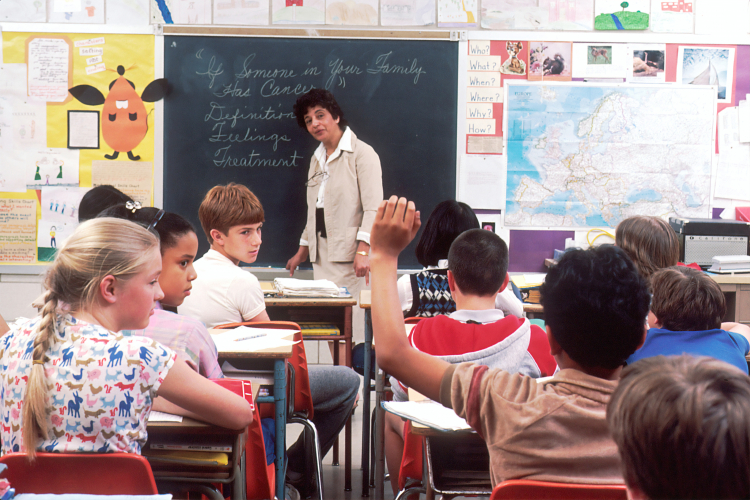
I see this dynamic play out in classrooms at every level. When a difficult question is posed, and the room is given time, real time, the first responses are often confident and wrong. The turning point comes when a student finally says, "I'm not sure." That moment changes the room. Other students lean in. The pace slows. The quality of thinking improves. What follows is no longer performance, but inquiry.
Yet our educational culture increasingly treats knowledge as theater. Students are rewarded for projecting certainty, even when that certainty is thin. Brash confidence is mistaken for competence. Guessing is encouraged over reflection. Children learn early, and many college students learn well that it is safer to say something than to say nothing. Decades of research on overconfidence confirm the cost: those most certain in their answers are often the least accurate, and the least likely to revise their thinking when confronted with evidence.
The result is a quiet distortion of intellectual character. Students become risk-averse in the wrong way: not afraid to be wrong, but afraid to be honest. They learn to bluff rather than ask. They internalize the idea that intelligence is about appearance, not understanding. Learning that allows no time for uncertainty teaches students that thinking is something done quickly or not at all.
Asking for help belongs in the same category. It is not a confession of inadequacy; it is a recognition that learning is relational. Educational research consistently finds that strong students across age groups are more likely to seek help strategically once they recognize a genuine gap in understanding. In my own teaching, uncertainty is never penalized, but it is never vague. Students are expected to say what they don't understand and why. That distinction - between confusion and carelessness - matters. It preserves rigor while encouraging honesty.
Serious education has always depended on apprenticeships, mentors, dialogue, and correction. This is as true in elementary classrooms as it is in graduate seminars. No one becomes excellent alone. The refusal to ask for help is not strength; it is pride disguised as independence.
What we reward in classrooms does more than shape academic behavior; it shapes beliefs. When students learn that uncertainty is acceptable and even valued, they remain open to revision, evidence, and dialogue. Research on intellectual humility reveals that students encouraged to acknowledge limits in their understanding are less dogmatic, more curious, and better able to engage opposing views. This stands in sharp contrast to a polarized culture that rewards conviction without examination and certainty without reflection. Much of what now passes for public debate looks less like moral clarity than an educational failure carried forward.
If we want students capable of judgment rather than just output, capable of citizenship, leadership, and moral reasoning, we must change what we signal as valuable. We must make room, explicitly, for uncertainty. We must model it as educators. We must praise students who pause, who ask clarifying questions, who say I don't yet understand.
As a teacher, some of the best moments in the classroom begin with "I don't know." Not because learning has failed, but because learning has finally become honest.
A healthy educational culture does not reward the loudest voice in the room. It rewards curiosity, restraint, and the courage to admit limits.
In an age saturated with hot takes and instant answers, I don't know may be one of the most radical and necessary things a student can say.
