


For Gen Z, Economics May Be the Key to Success in the New AI World
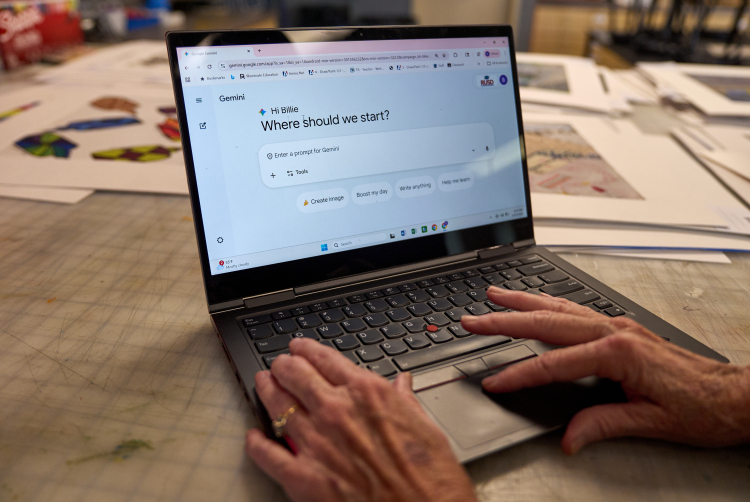
Members of Gen Z are right to ask: What jobs will be left for them in the new AI world? After all, artificial intelligence already can draft reports, reconcile accounts, write code, and generate marketing copy in seconds--and it's improving fast.
But new technologies do not eliminate work. They change what kinds of work matter. AI excels at tasks that follow rules and patterns. Feed it enough data and a clear objective, and it performs quickly and cheaply.
So, a better question for Gen Zers to ask is: What kind of education and training will hold its value when the tools we use keep changing?
In past waves of automation, employment and wage growth shifted away from routine, rule-based work and toward jobs requiring judgment, interpretation, and complex decision-making. If that pattern persists, the training most likely to hold value will not be narrow training in established procedures, but training in how to think when no established procedure exists.
Enter the economic way of thinking.
Economics provides analytical insight into open-ended problems. It begins with a simple truth: resources are scarce. Every choice has a cost. Time spent here cannot be spent there. Money invested in one project cannot fund another. Economics is all about evaluating such tradeoffs in a rigorous way.
The economic way of thinking also trains us to predict how people respond when resource scarcity changes. Raise a cost and behavior shifts. Change a rule, and incentives shift. Launch a new product, and competitors react.
AI lowers the cost of rote calculation. It does not eliminate the need for judgment. AI can generate projections—but someone must decide whether the assumptions make sense and what happens next. If anything, AI increases the rewards due to those with superior judgment.
When a model produces a forecast, someone must ask: What did we leave out? How might this decision ripple through the broader social system? Economics disciplines that kind of thinking. It forces attention on consequences, not intentions.
As AI tools become more widespread, the value of workers who can interpret results, design better rules, and anticipate behavioral responses is likely to rise. In the workplace, economics does not compete with other business disciplines. It strengthens them.
Finance is about allocating capital under uncertainty. Marketing is about understanding why customers choose one product or service over another. Accounting shapes how information builds trust. Management determines how organizations motivate people. Information systems reshape coordination and strategy.
Economics supplies the underlying logic. For example, it asks: What motivates people? What tradeoffs are unavoidable? How do rules shape behavior? Those who understand those questions can use AI much more effectively than those who know only how to query, but not what questions to ask.
It should be clear by now that AI will cause the routine portions of white-collar work— fields organized around highly standardized procedures—to shrink, while judgment-intensive portions—those organized around abstract reasoning and decision-making—will grow. It’s time for colleges, students, and employers to get ahead of the curve.
An accounting graduate who understands how rules influence behavior will add more value than one who simply follows checklists. A marketing graduate who understands how price changes affect demand will better interpret AI-generated analytics. A finance graduate who understands how economic conditions shape risk will make better decisions than one who only knows how to repeat what Claude or ChatGPT says.
Economics teaches us that education itself is an investment made under uncertainty. No student can predict the software, regulations, or industries that will dominate a decade from now.
Artificial intelligence will reshape many tasks. Workers who can think clearly about incentives, information, and tradeoffs, however, will always be in demand. In fact, the more powerful our tools become, the more those abilities will be valued.
In short, economics offers far more than a credential. It offers resilience.
Tools always change. Incentives do not. Economics trains us to understand the latter. That is why it remains a sound investment in an age of AI.
