


Radicalism Is Not Just in Higher-Ed. Our Political Institutions Need to Catch Up
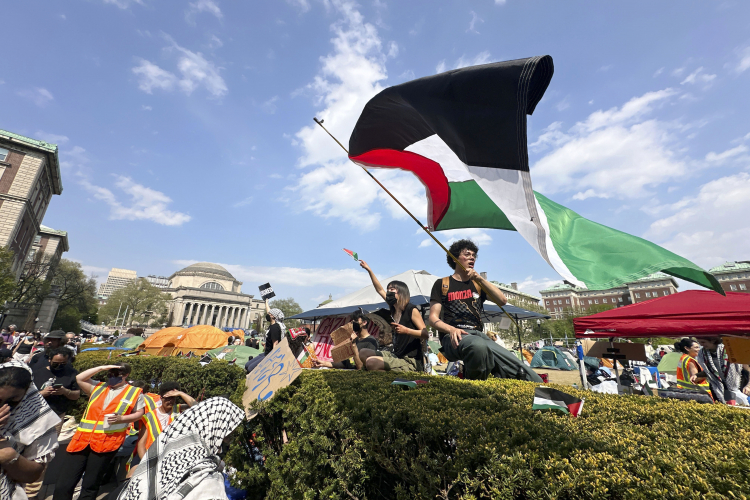
Recently, Rep. Elise Stefanik released a new book about her most viral moment in Congress and the fallout. In December of 2023, the presidents of multiple elite universities testified before Congress and Stefanik asked plainly, “Does calling for the genocide of Jews violate your university’s code of conduct?” University presidents wouldn’t answer, and shockwaves rippled across the country.
For the average Americans who consider it blindingly obvious that calls for genocide at U.S. educational institutions is unacceptable, the blinders were taken off about the situation on college campuses across the country. The conversation about radicalism and antisemitism in higher education has been a significant political focus since.
This focus on college campuses is unfortunately too narrow. The same issues plaguing college campuses are just as prevalent in K-12 education.Consider this: this past October 7th, the anniversary of the worst massacre of Jews since the Holocaust, a group of public school teachers calling themselves Philly Educators for Palestine co-sponsored a protest against the world’s only Jewish state. One graphic used to promote this event featured a bulldozer with a Palestinian flag running over a barbed-wire fence, an explicit reference to Hamas’s mass butchery. Their partners included Students for Justice in Palestine (SJP), a group closely linked to campus violence whose chapters were suspended by numerous universities for serious violations. Worse, Philly Educators for Palestine are actively recruiting students to participate in their events, including them in private social media chats, in clear violation of school district policies.
So far, those responsible for these events have faced no accountability. And this is in a school district already taken to task by the Biden Administration for antisemitism.
In Chicago, the first of May, known by activists as May Day, will see the city’s teachers using students as political foot soldiers for progressive causes. Across the country, other school districts plan to mobilize in much the same way.
While this phenomenon is worse in some districts than others, there are systemic problems nationwide. The National Education Association (NEA), one of the biggest teachers unions in the country, sent around a resource that erased Israel from the map, and, worse, linked to resources from organizations that are known to be fronts for terrorist organizations. Worse, many teachers unions are in bed with radical activists. Adam Sanchez, the Managing Director Rethinking Schools’ magazine, an organization that publishes antisemitic curriculum, attracted controversy for his presentation at a recent New Jersey Education Association (NJEA) convention that claimed Israel’s existence was a result of “a colonial war waged against the indigenous population,” and other politically and racially charged claims.
College students are impressionable, but K-12 students are even more so, and less likely to push back on authority figures.
This form of radicalism and antisemitism is intertwined with an oppressor and oppressed worldview. Those who promote this worldview have aggressively sought power in educational institutions, and have inserted their views into educational materials. They represent a small cadre of activists and do not represent anything like a majority, even in very “blue” districts. In other words: this is not an education problem, but a political problem, requiring a political reckoning.Political leaders are starting to understand this. Last fall, Chairman of the House Committee on Education and Workforce Tim Walberg (R-MI) announced investigations into three key school districts for antisemitism, and Chairman of the Senate Committee on Health, Education, Labor and Pensions (HELP) Bill Cassidy (R-LA) sent a letter to the National Education Association demanding it answer tough questions about their far-left activism and antisemitism. Leaders such as Gov. Josh Shapiro (D-PA) and Rep. Josh Gottheimer (D-NJ) have spoken out on this issue.
The overlapping layers of how public schools are administered, including administrations and school boards, state and federal legislatures and agencies, and the role of the nonprofit industry, make change difficult and slow. Our political leaders should pick up the pace and prioritize depoliticizing our schools. There hasn’t been a single, galvanizing moment for K–12 the way there was for higher education. But that’s not a comfort—it’s the problem. Without that moment, the same extremism is taking root with less attention and fewer consequences.
We already know how this ends. The only question is whether leaders step in now—or wait until it’s impossible to ignore.
