


The Commencement Lectern Is Not a Pulpit
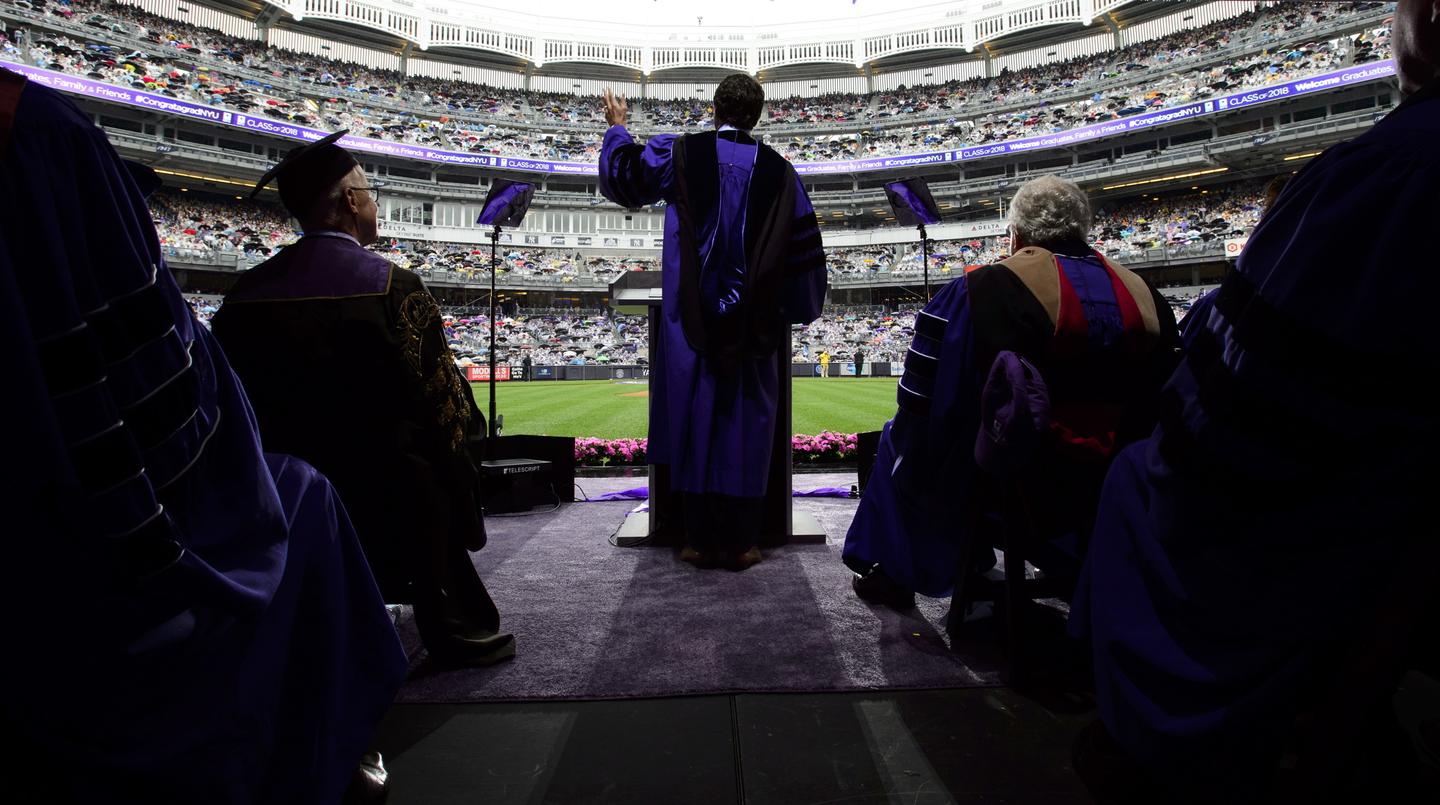
At the University of Michigan’s 2026 commencement exercises, history professor Derek Peterson stood before graduating seniors and their families and, as chair of the Faculty Senate, used his five minutes at the commencement microphone to praise pro-Palestinian campus activists for opening “our hearts to the injustice and inhumanity of Israel’s war in Gaza.” The line drew applause. It also drew, according to Inside Higher Ed, nearly 500 angry emails, twenty threatening calls, a public apology from university president Domenico Grasso, calls from Republican regent candidates to discipline him, and a counter-letter from more than 1,100 affiliates demanding the president apologize for apologizing. A graduation ceremony - a moment meant to belong to students and families - became, within hours, another front in the campus culture wars.
I have no interest in adjudicating Peterson’s views on the war, his critics’ views, the regents’ threats, or the president’s clumsy attempt to thread the needle. The deeper problem sits one level up and it is this very simple idea: It is the recurring, almost compulsive instinct among faculty to treat every microphone, every syllabus, and every graduation stage as a venue for personal political witness and the bewildered surprise when the rest of the world responds.
I have taught at Sarah Lawrence College for nearly two decades. This year alone I led two yearlong seminars, one on political polarization and another on politics and geography. Both sit squarely on contested terrain. I hold strong political views. My students often know I have them; they just do not know what they are. When explicitly asked, I make it clear that I keep my personal political views out of the classroom as they are not relevant for our work. That is not an accident. It is a professional commitment.
The classroom is not my soapbox, and the lectern is not a pulpit. As the credentialed adult in the room, my asymmetric authority over grades, recommendations, and the social temperature of the seminar means that when I tip my hand, I do not start a debate - I end one. Quiet students get quieter. Dissenting students self-censor. The bright young conservative, the observant Muslim, the Orthodox Jew, the first-generation skeptic; they read the room, calculate the cost, and stop talking. What I gain in the warm glow of moral self-expression, I lose many times over in the room’s intellectual life. Neutrality, properly understood, is not cowardice. It is the precondition for a real argument, the promotion of authentic viewpoint diversity, deep engagement, and meaningful learning.
The same logic scales up to the commencement stage. A graduation is not a faculty meeting or a teach-in. It is a civic ritual that belongs to thousands of families, many of whom traveled across the country, who hold every conceivable political view, and whose children spent four years and six figures earning their place in those folding chairs.
When a senior faculty officer uses that platform to render a contested geopolitical verdict - even one he sincerely believes is “innocuous,” as Peterson told Inside Higher Ed - he is not exercising academic freedom. He is conscripting a captive audience. The grandmother who lost a cousin in Israel did not buy a ticket to that argument. Neither did the Palestinian-American student’s parents. Neither did the engineering major who simply wanted his degree.
The defense one hears in these episodes is always the same: refusing to take a stand is itself a political act, silence is complicity, the moment demands moral clarity. This is the rhetoric of the activist, not the educator. It collapses the distinction between teaching and advocacy that has, for generations, been the basis of the professoriate’s claim to public trust. And it explains, more than any external assault, why that trust has corroded so badly. The most recent Lumina-Gallup data shows confidence in higher education ticking up modestly to 42 percent in 2025 - but among Americans who lack confidence, 38 percent now cite political agendas as the chief reason, up from 28 percent the year before. The public is telling us, in survey after survey, exactly what it sees.
There is a richer tradition available to us. Max Weber, in his 1917 lecture Science as a Vocation, warned that “the prophet and the demagogue do not belong on the academic platform” - because, he added, “it is somewhat too convenient to demonstrate one’s courage in taking a stand where the audience and possible opponents are condemned to silence.” That sentence ought to be engraved over every faculty lectern. Tocqueville understood, too, that institutions sustain themselves only when those entrusted with them practice a discipline of restraint. The framers of the modern American university built tenure not so faculty could broadcast their convictions from every microphone, but so they could pursue the truth without fear, including truths inconvenient to their own side.
A commencement is not the place to settle Gaza. A seminar is not the place to settle Trump. A faculty meeting is not the place to settle anything beyond faculty business. The job is to elevate students, all of them, and to model the disciplined humility that distinguishes a teacher from a partisan. That is not complicated. That so many of my colleagues find it impossible is the scandal and the story.
