


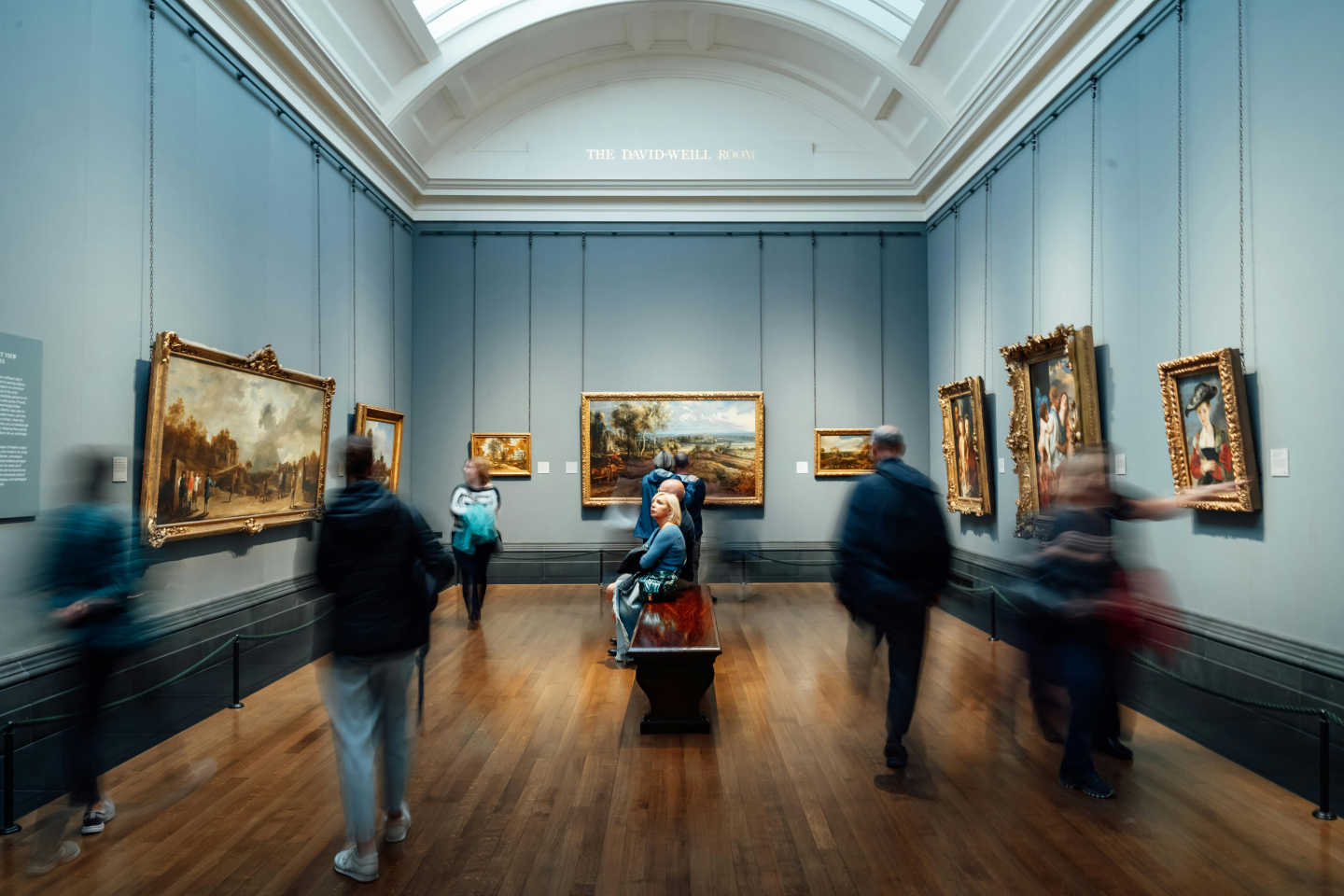
The Benefits of an Afternoon at the Art Museum
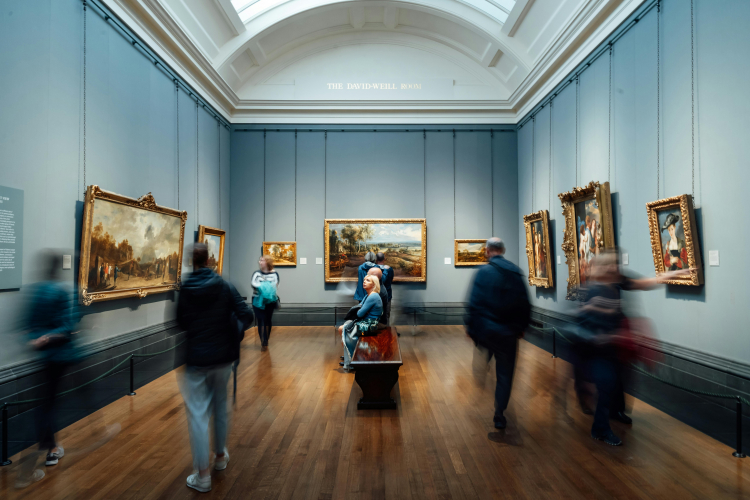
Educators and psychologists have long recognized the benefits of art creation as part of a child’s education. But simply spending time among great works of art can be even more rewarding. That’s why I invite you to skip the pool or park one Saturday afternoon and take your kids to an art museum instead.
As a school docent at a major art museum, I’ve spent the last ten years taking students on tours of our gallery. I’ve seen with my own eyes, and heard with my own ears, the benefit from meeting great works of art face-to-face. What a joy to watch kids from ages four through high school open their eyes and hearts to the beauty of art!
You don’t have to take my word for it. The British educator and reformer Charlotte Mason (1842-1923), one of modern-day home-schooling, as well as one of classical education’s key influencers, saw the value of educating children in the study of art history more than a century ago.
Children’s minds are hungry for ideas, Mason reasoned. Just as Great Books provide intellectual sustenance, she saw the arts as providing “picture study” – the careful study of a body of paintings from a single artist or era each term – as a complement to the broader curriculum.
As she wrote, “education should furnish a child with whole galleries of mental pictures, pictures by great masters, and of the greatest events in history.”
There are other advantages to in-person encounters with great art in today’s world. Being present in the company of a painting or sculpture is to step away from the many distractions that dominate modern life. In addition to providing screen-free quality family time, taking in and discussing works of art has other developmental and cognitive benefits.
“To see takes time, like to have a friend takes time,” the artist Georgia O’Keefe once said. Looking at works of art encourages you to slow down and pay attention, practices we could all benefit from in our fast-paced, screen-dominated world.
Here are some ideas for activities to undertake in the museum with your own kids:
When initially approaching a new work of art, I have the students partake in close looking. A minute of careful observation allows the viewer to slow down and focus on both the overall majesty of the work, but also the small details. We might start ten or twelve feet away from a large canvas, to take in the overall impression, then move much closer to notice the details.
Jasper Cropsey’s “Autumn- on the Hudson River,” for example, a celebration of American national pride, works beautifully with this exercise. From far away, the canvas represents a celebration of the wonders and colors of fall. One critic in 1860 called it, “not the solemn wasting away of the year, but its joyful crowning festival.”
But observed from a closer vantage point, we can notice the details. Specifically the energy and joy of life which Cropsey provides through people and animals, in contrast to the startling splendor of nature; men leisurely picnicking on the banks, a couple enjoying the day from the bridge, and some big, beautiful cows gently easing themselves into the stream. Such exercises foster concentration, and the ability to pay attention, which is constantly challenged in today’s world.
For young and old alike, taking in a great work of art can inspire creativity, imagination and wonder. Edward Hopper began drawing at age five. Picasso started painting at seven, and Paul Klee included many of his childhood sketches in his adult work. We don’t, of course, all emerge to become renown artists, but an early introduction to great art can spawn a lifelong love of drawing or painting.
Experiencing works of art encourages other creative genres. As a writer, I love to use paintings to inspire narrative, joining the processes of art making to that of story creation. For younger children, “The Dancing Couple” by the 17th century Dutch artist Jan Steen provides opportunities to tell the story of the painting, in which jovial characters enjoy a day of celebration, dancing, laughing, talking, complete with food, drink, and toys for the children.
I have early learners pick a character from the festive scene and assign them a name. Older students can create a bit of back story for their individual, and high schoolers enjoy constructing a more detailed narrative explaining the story.
Even abstract work provides the opportunity to inspire creative narrative. At the museum where I am a docent, we are fortunate to have a large collection of Mark Rothko paintings, many of which are displayed in a gallery dedicated exclusively to the artist’s work.
With his many large color field paintings, Rothko was intent on conveying intense emotion. When divided into groups of two or three and positioned in front of one of the huge canvases, I asked my recent group of 10th graders what emotion their assigned canvases inspired.
One group produced a tale of despair and desperation, in which their fictitious main character, heavily burdened and melancholy, sat enclosed in a cell. A fine line of gold, however, peeking out from between the dark, heavy, blocks of color represented, the group explained, a strong sense of hope. How fascinating to hear their intense reactions to the abstract canvas, while also identifying a narrative in a painting with no figurative components.
Charlotte Mason wanted her students to leave school with a well-stocked visual imagination, “…because imagination has the property of magical expansion, the more it holds the more it will hold.”
That visual imagination is something every child, and every parent, can discover and build through visits to their local art museum.
