


Be Absent
School started again a few weeks ago, and with it came the annual chorus about America's chronic-absenteeism crisis. Nearly a quarter of American students still miss school regularly. Ohio schools this year decided that it no longer matters whether an absence is excused: missed is missed, which means somewhere an administrator has decided that even I don't get to excuse my own kid anymore. Eight members of the current Congress, meanwhile, have missed more than 15 percent of their own votes this term. Nobody has suggested routing them through youth court.
I already know how this story goes for my family, because I got the letter back in March.
School letterhead, tucked into the mail between a Menards flyer and a dental reminder, addressed to the parent or guardian of my son, Granger, informing me that he had accumulated 7.5 unexcused absences.
Seven and a half.
The letter was drenched in that faux friendliness that only lightly masks the we'll-let-it-slide-this-time-but-we-know-better attitude. Attendance, it explained, is essential to academic success. Absences can accumulate "without parents realizing how many days have been missed," as though losing track of your kid were a known hazard of parenting. We currently had "the opportunity to work towards improving attendance without further intervention." At ten, the social worker might become involved. Then it thanked me in advance for my support and cooperation, which is the sentence bureaucracies deploy when neither is actually being requested.
The letter isn't really about attendance. It's about control. It wants you to feel you've slipped, that the responsible move is to fall back in line before it escalates. That feeling is the entire product.
No teacher who knows my son wrote it. Nobody called. The principal signed it, but the true author was the attendance policy stapled behind it.
For the record, the absences included a stomach bug, the usual fever or two, one day at home for no reason except that we wanted one, and three museum days: the Field Museum, the Museum of Science and Industry, the Adler Planetarium, each followed by an ever larger portion of parks and playgrounds and, of course, something delicious downtown. They were unexcused because I never felt they needed excusing.
My reaction was fairly immediate: who the hell are they to decide what my kid does? Who established that a Tuesday in the seat serves Granger better than a morning under a T. rex, an afternoon dismantling something in the garage, a day on the water, or a shift alongside me at work?
The strange thing is how little we challenge that premise. Schools track attendance because attendance is what schools can track. A child walks through the door at 8:05 and the machine records success. He spends the same Tuesday wandering the Field Museum with his father and the machine records failure. It knows nothing about either day beyond the location of his body. Nobody builds a dashboard for the metrics that are actually uncomfortable, either: how much of the budget reaches a classroom versus an office, whether the scores justify the spending, how many good teachers left this year and why. Attendance is just the number that's easy to get and easy to blame someone else for.
The whole apparatus is a fairly recent invention, as these things go. Compulsory attendance laws are barely more than a century old, built for a country that needed children out of factories, not out of the Field Museum. Machinery designed for one problem got repointed at fathers who'd merely developed strong opinions about the Adler Planetarium.
Next month brings Attendance Awareness Month, complete with campaigns, toolkits and solemn warnings about the terrible things that happen when children fail to occupy their assigned seats. Meanwhile school districts themselves, more than 850 of them, have discovered that Friday can disappear entirely when staffing or budgets make a four-day week attractive. A canceled Friday is innovation. A taken one gets you a letter.
But the word in the letter that really stuck with me was unexcused.
Excused by whom?
Granger did not slip out a side door and spend the day ripping cigs behind a 7-Eleven. I knew where he was. I put him in the car and took him there.
That is a remarkable inversion of the relationship, and one we mostly accept without noticing. Somewhere along the way the school calendar stopped being a schedule telling families when school was available and became a claim on the child's time, a soft, permanent custody arrangement nobody remembers agreeing to. If you want him back on a Tuesday, you are expected to explain yourself. Better make it educational.
A few weeks after the letter showed up, we took another Friday. I'd like to tell you this was because I had designed an unusually rich learning experience. Mostly the weather looked good and the letter had annoyed me.
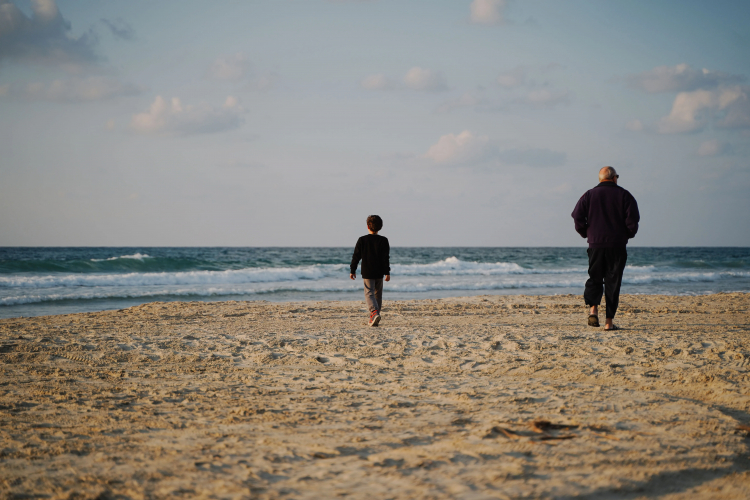
Lake Michigan on a school morning belongs mostly to gulls and truants, so we had a good portion of it to ourselves. We hiked the trails, just miles from his school, through the dunes until we found the beach. Granger discovered half of a fish and became deeply interested in the forensic possibilities. Waverly collected rocks with acquisitive focus. We went to a bookstore, where I was conned into considerably more toys than books. Eventually somebody complained about being hungry, so we ate.
I made no effort to redeem the day academically. The fish did not become a unit on freshwater ecology. Nobody calculated the volume of Lake Michigan or wrote a reflective essay on dune erosion. The rocks were not sorted in such a way as to align with Indiana state science standards. We just spent a Friday together.
Not every worthwhile hour of childhood needs to produce evidence. Public schools spend about $18,600 per kid per year, a little over $100 for each school day. I spent less than that on lunch, parking and a chintzy toy. Granger found half a fish. I'd venture to say I'm winning. And even if the school were doing a marvelous job, it still wouldn't hold superior moral title to every weekday of my kid's childhood.
Still, parents have learned the ritual. Take the child out of school and immediately begin constructing the defense. Gettysburg had history. The aquarium had marine biology. Yellowstone had geology. The garage project involved engineering. Most often, though, the trip does not happen at all. We have become so accustomed to school owning the weekday that we police the boundary ourselves.
We have not lost the appetite for control, though, only the habit of exercising it anywhere it counts. That instinct just never seems to reach the 180 days already printed on the calendar.
So here is my modest proposal for the new school year: be absent.
Take a Friday. Take the kid to a minor-league ballgame in the cheap seats, where a foul ball is a real and present danger. Build something in the garage that may never work. Go see the grandmother with the good stories. Walk a beach. Stand in a junkyard and let him ask why things break. Or do absolutely nothing worth reporting. Stay home, make pancakes, let the day happen to you instead of the other way around.
None of that will show up on a dashboard. Good.
The school calendar isn't a custody agreement. It's 180 dates printed on a piece of paper by an institution we entrusted to help educate our children, not raise them. Entrusted has a way of evolving into entitled. Thirteen years is a hell of a lot of Fridays to surrender before noticing.
Which brings me back to chronic absenteeism. We talk about it as though the empty chair were itself the disease. It isn't. The empty chair is information, which may be why the people counting them are so determined not to ask what they mean.
There are, broadly, two kinds. The first is the one behind all the alarming headlines: the kid who simply stops showing up. Sometimes there is real trouble behind that, and nobody should romanticize it. But sometimes the message is considerably simpler. School has failed to persuade him that another day inside it is worth having. He has looked at the bargain on offer and, with all the subtlety of adolescence, declined. The adults respond with attendance campaigns, warning letters, court referrals and dashboards, anything except asking whether the kid has a point.
Then there is the more deliberate kind, which is mine. I am not waiting for Granger to become sixteen, bored stiff and sufficiently alienated to discover for himself that there is a world outside Room 204. Every so often I look at the day school has planned for him, look at the alternatives, and make the same judgment on his behalf. The museum wins. The garage wins. The beach wins. Half a fish wins. This is not because school is worthless. It is because the proposition that school must be the most valuable use of every child's time, every weekday, 180 times a year, is ridiculous on its face.
The two kinds of absence are not morally identical, but they contain the same piece of heresy: sometimes there is somewhere better to be. That is the thought the attendance bureaucracy cannot permit, because the moment parents begin making that judgment for themselves, attendance stops looking like a duty and starts looking like a choice. And choices require institutions to earn them.
So yes, be absent. Deliberately. Cheerfully. Without a doctor's note, an educational justification or the slightest interest in whether the absence has been blessed by somebody sitting behind a district desk. Not neglected. Not lost. Absent. Childhood is short. The school year is long. I can spare a few Fridays.
The letter is out of the drawer now. I have it framed. Read from the school's side, it is a warning. Read from mine, it is a record of several days that escaped the ledger: the Field, MSI, the Adler, one perfect and pointless day at home, a beach, a bookstore, half a fish. My children will eventually forget most of it anyway. Granger may forget what exhibit we saw at the Adler, and Waverly will certainly lose the rocks. Childhood keeps only scattered pieces: a smell, a room, a joke, the afternoon Dad inexplicably said to hell with school.
I have yet to meet an adult who looks back and wishes there had been fewer of those mornings.
This year we are going for ten. If the social worker would like to discuss it, she is welcome to come along.
We will be at the planetarium.
